All published articles of this journal are available on ScienceDirect.

Life Cycle Assessment of Roofing Systems in Buildings: Green Roofs vs. Conventional Roofs
 iD
iD
Authors Info & Affiliations
Abstract
Introduction
Green roofs are roofing systems designed to reduce the environmental impact of buildings; however, the production of the materials used in their construction can generate significant impacts. This research aimed to measure the environmental impacts of the production and use of 1 m2 of an extensive green roof, comparing the results with those of a conventional roof and other green roof systems reported in the literature (intensive and extensive).
Methods
To this end, Life Cycle Assessment (LCA) was used as the methodology, following the ISO 14040/14044 standards, and the impact calculation was performed using the openLCA 2.0® software. The categories analyzed were: abiotic depletion of fossil fuels, terrestrial ecotoxicity, photochemical oxidation, global warming potential (100 years), and human toxicity.
Results
The results showed a 5% reduction in terrestrial ecotoxicity and a 6% reduction in photochemical oxidation for the extensive green roof analyzed in this study. For fossil fuel depletion, 100-year global warming potential, and human toxicity, the green roof had higher impacts than the conventional roof, with increases of 10%, 4%, and 3%, respectively.
Discussion
Although green roofs may cause higher production impacts, they can provide environmental benefits during use, such as pollutant removal. The better overall results of the extensive green roof highlight its potential as a more sustainable roofing option.
Conclusion
A contribution analysis revealed that the most polluting materials in both systems are the concrete and steel used in the supporting structure. Therefore, to improve the environmental performance of green roofs, it is recommended to use more sustainable materials and reduce the consumption of materials identified as the most polluting.
1. INTRODUCTION
The construction sector is recognized as one of the major contributors to environmental degradation due to its high consumption of energy, raw materials, and non-renewable resources [1]. Consequently, sustainable construction approaches have gained increasing relevance, particularly those focused on improving the environmental performance of building systems throughout their life cycle. As a result, methods capable of assessing the environmental impacts associated with construction materials and systems have become increasingly relevant in the construction sector, particularly for evaluating the environmental performance of emerging sustainable building technologies.
In this context, green buildings have been developed, which refer to structures that aim to achieve environmental sustainability goals throughout their life cycle, such as reducing energy consumption, minimizing waste and pollution, lowering carbon emissions, improving air quality, and using green materials in construction [2]. These concepts are used in different construction applications, such as green roofs, ventilation systems, waste management policies, and recycled materials [3].
The current urgency to incorporate sustainable concepts into civil construction arises from the significant share of environmental impacts associated with the sector. According to the 2024 Global Status Report for Buildings and Construction by the United Nations Environment Programme [4] CO2 emissions related to the operation and construction of buildings reached record levels in 2022, with 10 GtCO2 (gigatons of carbon dioxide) emitted. These emissions accounted for 37% of the global total, distributed between building operation and the production of construction materials [4].
The report by the International Energy Agency [5] presents scenarios highlighting the significant contribution of the building sector to global energy consumption, with particular emphasis on the growing demand for electricity for space cooling. In this regard, it is worth noting that electricity use accounted for 37% of total energy demand in 2023. The construction sector accounted for 30% of the final global energy demand when considering operational needs such as heating and cooling, and up to 34% when the impacts associated with the production of construction materials were included [4].
The presence of trees and green spaces in urban environments is essential for improving the population's quality of life, whether through air quality regulation or enhanced thermal comfort. However, urbanization and the increasing density of construction have limited the availability of green spaces [6]. Consequently, there is an inherent conflict of interest between urban growth and the mitigation of environmental impacts in the construction sector.
The paradox between urban growth and the mitigation of environmental impacts in the construction sector drives the inclusion of new urban development strategies, such as green infrastructure with nature-based solutions. Examples include rain gardens, green roofs, and green walls, which aim to minimize the effects of urbanization and improve the environment in a given space [7, 8].
With the potential to mitigate the urban heat island effect, green roofs improve thermal comfort in buildings during periods of high and low temperatures, acting as a barrier to solar radiation in the summer and helping to retain heat during the winter [9].
Previous investigations have highlighted the multifunctional role of green roofs in urban environments, particularly regarding stormwater management, air quality improvement, biodiversity support, reductions in energy consumption, and contributions to urban resilience and sustainability [10-13]. The literature also highlights the relevance of green roofs as nature-based solutions capable of supporting climate change adaptation strategies in urban areas [12]. It is further emphasized that the environmental performance of green roofs may vary according to climatic conditions, system design, and operational characteristics [11, 13].
An integrated assessment of the environmental impacts and benefits of green roofs contributes to the advancement of the development of this type of infrastructure towards increasingly sustainable models, while also allowing the identification of more sustainable materials to be incorporated into these roofing systems [14]. The application of the Life Cycle Assessment (LCA) methodology is suggested in the literature for measuring the impacts of using green roofs [15]. Examples of LCA applications in building roof systems include the investigations of [16-18].
Recent studies have demonstrated the growing application of LCA in supporting sustainability-oriented approaches and environmental objectives in the construction sector, particularly by enabling the evaluation of the environmental performance of construction materials and infrastructure systems [19-22]. These studies also emphasize the importance of considering alternative and recycled materials in environmental assessments, reinforcing the relevance of LCA as a tool for assessing environmental impact reduction and supporting sustainable decision-making in civil engineering and construction practices.
Focusing on low-income countries, the results of applying LCA (Life Cycle Assessment) to green roofs show that it is possible to reduce environmental impacts throughout the life cycle of green roofs by using lightweight, recycled, and locally sourced materials. The suggestion of using locally sourced materials is related to the possibility of reducing transportation-related impacts [23].
In a previous LCA application to measure the impacts of replacing a conventional roof with a green roof, it was identified that the environmental impacts related to ozone layer depletion, water acidification, water eutrophication, and Global Warming Potential (GWP) were reduced by approximately 40-50% during the construction, maintenance, and disposal phases of the green roof [24]. A similar approach was carried out in Lebanon by [25], and the results were favorable to the use of green roofs, considering water scarcity and reduced energy consumption.
The different methodological choices and assumptions, as well as the types of green roofs evaluated (extensive, semi-intensive, and intensive green roofs), can yield quite distinct results. Therefore, understanding the effects of these choices on environmental impact outcomes is a relevant issue, especially for identifying which type of green roof is most appropriate [26].
Given the above, previous LCA investigations on green roofs have explored different environmental aspects and advantages; however, comparative evaluations between different green roof models, as well as comparisons with conventional roofing systems, are still relatively limited within the same assessment framework. In addition, aspects such as variations in layer composition and the potential pollutant reduction associated with vegetation during the use phase may not always be considered in previous investigations.
Therefore, the objective of this investigation is to measure the environmental impacts associated with the production and use of 1 m2 of green roof and compare the results with those of a conventional roof. To achieve this objective, the Life Cycle Assessment methodology was applied, considering the following impact categories: abiotic depletion of fossil fuels, terrestrial ecotoxicity, photochemical oxidation, global warming potential (100 years), and human toxicity. As distinguishing features of this investigation, the comparative approach considered both the different components of the layers and the potential for pollutant reduction through vegetation on green roofs, as well as the variations in the types of green roofs identified in the literature.
2. MATERIALS AND METHODS
This study followed the environmental management standards ISO 14040 [27] and ISO 14044 [28] for Life Cycle Assessment (LCA). The method employed followed procedures analogous to common approaches for conducting LCAs, consisting of the following stages: definition of goal and scope, inventory of inputs and outputs, impact characterization, and interpretation. One distinguishing aspect of this research was the inclusion of pollutant removal values provided by the vegetation on top of the green roof, which were quantified according to the type of pollutant removed over a given period.
The potential impacts of the green roof were compared to those of a conventional roof using materials from the Ecoinvent 3.6 database. To determine the results, the software openLCA® 2.0 and the CML 2001 method were used.
2.1. Goal and Scope
The goal and scope of this study consisted of selecting the manufacturing and use stages of 1 m2 of a green roof, as well as the manufacturing stage of 1 m2 of a conventional roof. Based on this, two product systems were developed: the first, presented in Fig. (1a), illustrates the life cycle stages of the green roof considered in this research; the second, in Fig. (1b), presents the corresponding stages for the conventional roof, with a similar scope.
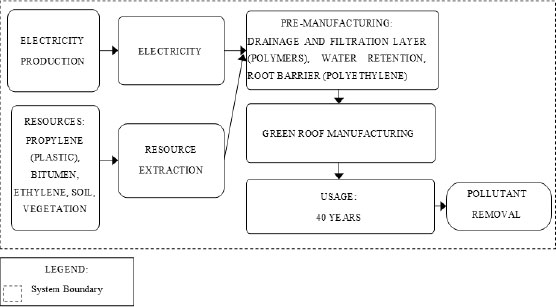
Product system of the green roof.
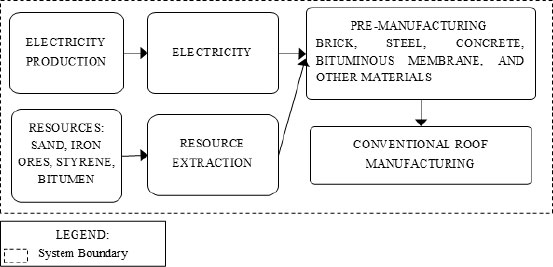
Product system of the conventional roof.
It is noted that the system boundaries defined for the product systems-represented by the system boundary-cover the stages from cradle (raw material extraction) to the use phase of the roofs after their manufacturing. The transportation of materials was considered using the “market” supplier selection approach available in the Ecoinvent 3.6 database, which includes the estimated transportation of inputs within the geographical area of each supplier.
Although the use of 1 m2 of roof area as the functional unit allows a standardized comparison between the evaluated roofing systems, this approach may underestimate the potential benefits associated with the use phase of green roofs, particularly regarding additional functions such as thermal insulation, stormwater retention, air pollutant removal, and biodiversity support.
It is important to highlight that this study did not take into account the environmental impacts associated with the practical installation process of the roofs, such as labor, equipment, and on-site execution, as these factors can vary significantly depending on the height, shape, and location of the building. Maintenance of the green roof was also excluded from the assessment, as it depends on factors such as usage patterns, vegetation type, and climate conditions. Finally, due to a lack of quantitative data on the potential benefits of green roofs-such as biodiversity conservation and energy savings from reduced air conditioner use-these advantages were not included within the scope of the study.
Impacts associated with maintenance activities and operational energy consumption were not included in this assessment due to the high variability related to climatic conditions, building use patterns, and maintenance strategies. Therefore, the study focused on the impacts associated with material production and the environmental benefits related to atmospheric pollutant removal.
2.2. Input and Output Inventory
To prepare the input and output inventories, data from the literature were consulted regarding the quantities of materials used in the construction of green and conventional roofs. The input and output processes were adapted from the referenced materials to correspond to flows available in the Ecoinvent 3.6 database. Based on this, information from global providers was used, categorized geographically as RoW (Rest of the World), GLO (Global), or Brazil (BR).
2.2.1. Green Roof
To define and quantify the component layers of the green roof, the study by Chenani et al. [29] was used as a reference. The selected materials were those, according to the authors, that demonstrated the best environmental performance in the construction of green roof layers.
Since the component quantities provided by the aforementioned authors did not include the vegetation cover, this layer was based on the value used by [16]. However, it is important to note that the type and quantity of vegetation may vary depending on the specific plant species chosen for use. It is worth noting that the atmospheric pollutant removal performance associated with vegetation may vary according to factors such as the adopted plant species, local climatic conditions, vegetation density, and pollutant uptake capacity.
In an extensive green roof system, the green roof layers were thus divided into a protection layer, root barrier, drainage layer, water retention layer, filtration layer, soil layer, and vegetation cover, as illustrated in Fig. (2).
In addition to the specific green roof layers, a structural support base adapted from Giama et al. [16] was also considered. This base is composed of materials such as concrete and steel to form the structural support, as well as thermal insulation and asphalt mastic for waterproofing.
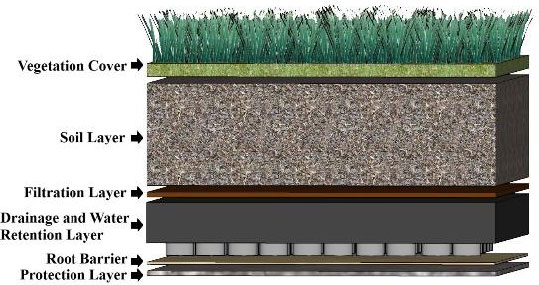
Representation of green roof layers.
According to Morau et al. [23], the component layers of a green roof serve important specific functions that enable its effectiveness. The authors state that the vegetation cover is the main part of this system, providing environmental benefits. As for the soil or substrate layer, it plays a role in vegetation nourishment and also in stormwater management. The other green roof-specific layers are grouped by the authors as part of protection functions - either to prevent root penetration into the roof support or to allow for rainwater drainage and filtration. Finally, the structural base serves as the support for the entire green roof system.
To improve the representativeness of the environmental performance analysis, quantitative values related to pollutant removal over the green roof’s use phase were considered, based on the data presented by Yang et al. [30]. These data were applied as output flows in the study, assuming a 40-year use period, representative of the roof’s service life [29]. These values are presented in Table 1, where the pollutants removed by the vegetation considered in this study were nitrogen dioxide (NO2), sulfur dioxide (SO2), ozone (O3), and particulate matter with a diameter of 10 micrometers or less (PM10), in quantities based on the work of the aforementioned authors. It is worth noting that the environmental performance associated with vegetation may vary according to the plant species adopted, climatic conditions, substrate thickness, biomass production, and atmospheric pollutant uptake capacity.
| Removed Pollutant | Quantity | Unit |
|---|---|---|
| Nitrogen Dioxide (NO2) | 2.33 | g / (m2. year) |
| Sulfur Dioxide (SO2) | 0.65 | g / (m2. year) |
| Ozone (O3) | 4.49 | g / (m2. year) |
| Particulates (PM10) | 1.12 | g / (m2. year) |
All components presented for the green roof were linked to the data on natural resource consumption available in the Ecoinvent 3.6 database, with the process inputs being obtained for calculations in the openLCA 2.0® software. The pollutant reduction values were used as outputs, with a 40-year use period assigned, and a negative value was applied so that it would be subtracted from the total pollutant emissions sum. Table 2 presents the input and output inventories developed for the green roof, detailing the components and their respective quantities (expressed as weight per unit area), along with the corresponding Ecoinvent 3.6 material flows.
| Type | Component | Material | Amount | Unit | Ecoinvent 3.6 Flow |
|---|---|---|---|---|---|
| Input | Protection layer | Non-woven polypropylene (TNT) | 0.3 | kg/m2 | Market for textile, non-woven polypropylene | textile, non-woven polypropylene | Cutoff, U - GLO |
| Root barrier | Low-density polyethylene | 0.8 | kg/m2 | Market for polyethylene, low density, granulate | polyethylene, low density, granulate | Cutoff, U - GLO | |
| Drainage layer | Recycled polystyrene | 1.3 | kg/m2 | Market for polystyrene scrap, post-consumer | polystyrene scrap, post-consumer | Cutoff, U - GLO | |
| Filtration layer | Non-woven polypropylene (TNT) | 0.15 | kg/m2 | Market for textile, non-woven polypropylene | textile, non-woven polypropylene | Cutoff, U - GLO | |
| Water retention layer | Recycled mineral wool | 1.2 | kg/m2 | Market for waste mineral wool | waste mineral wool | Cutoff, U – RoW and treatment of waste mineral wool, recycling | waste mineral wool | Cutoff, U - RoW | |
| Soil layer | Fertilizer (Manure) | 15 | kg/m2 | Market for manure, solid, cattle | manure, solid, cattle | Cutoff, U - GLO | |
| Sand | 15 | kg/m2 | Market for sand | sand | Cutoff, U - BR | ||
| Pumice | 70 | kg/m2 | Market for pumice | pumice | Cutoff, U - GLO | ||
| Vegetation cover | Grass | 10 | kg/m2 | Market for grass, organic | grass, organic | Cutoff, U - GLO | |
| Roof support base | Ready-mix concrete | 1235.9 | kg/m2 | Market for concrete block | concrete block | Cutoff, U - BR | |
| Steel | 13.5 | kg/m2 | Market for reinforcing steel | reinforcing steel | Cutoff, U - GLO | ||
| Extruded polystyrene (XPS) insulation | 1.74 | kg/m2 | Market for polystyrene, extruded | polystyrene, extruded | Cutoff, U - GLO | ||
| Asphalt mastic | 0.2 | kg/m2 | Market for mastic asphalt | mastic asphalt | Cutoff, U - GLO | ||
| Output | Air pollutant removal by vegetation | Nitrogen dioxide (NO2) | -0.0932 | kg/m2 | Nitrogen dioxide |
| Sulfur dioxide (SO2) | -0.026 | kg/m2 | Sulfur dioxide | ||
| Ozone (O3) | -0.1796 | kg/m2 | Ozone | ||
| Particulate matter (PM10) | -0.0448 | kg/m2 | Particulates, < 10 um | ||
| Product | Green roof | 1 | m2 |
Abbreviations: U = Unity process, BR = Brazil, GLO = Global.
2.2.2. Conventional Roof
To conduct a comparative analysis, a quantitative survey was carried out for the components of a roof not categorized as a green roof, referred to in this study as a conventional roof. For this purpose, the horizontal roof presented by Giama et al. [16] was used, as the authors also conducted a comparative analysis with the green roof, which aligns with the objective of the present study.
The materials composing the conventional roof are identical to those of the support base used in the green roof. Therefore, concrete and steel were used for the structural base, asphalt mastic for waterproofing and void filling, and extruded polystyrene for thermal insulation.
As with the green roof, the components of the conventional roof were adapted to the flows available in the Ecoinvent 3.6 database, applied as inputs for impact calculations in the openLCA 2.0® software.
Table 3 presents the input and output inventories for the conventional roof, detailing the components and their respective quantities (expressed as weight per unit area), along with the corresponding Ecoinvent 3.6 material flows.
| Type | Component | Material | Amount | Unit | Ecoinvent 3.6 Flow |
|---|---|---|---|---|---|
| Input | Roof support base | Ready-mix concrete | 1235.9 | kg/m2 | Market for concrete block | concrete block | Cutoff, U - BR |
| Steel | 13.5 | kg/m2 | Market for reinforcing steel | reinforcing steel | Cutoff, U - GLO | ||
| Extruded Polystyrene (XPS) insulation | 1.74 | kg/m2 | Market for polystyrene, extruded | polystyrene, extruded | Cutoff, U - GLO | ||
| Asphalt mastic | 0.2 | kg/m2 | Market for mastic asphalt | mastic asphalt | Cutoff, U - GLO | ||
| Output | Product | Conventional horizontal roof | 1 | m2 |
Abbreviations: U = Unity process, BR = Brazil, GLO = Global.
2.3. Impact Categories
For impact characterization, the CML-IA baseline methodology from the Institute of Environmental Sciences (CML) at Leiden University was used. With this method, the results of the life cycle analysis conducted in the openLCA 2.0® software are separated into impact categories. Among the base impact categories of the CML, the following were selected for this study: Abiotic Depletion of Fossil Fuels (ADPF), Terrestrial Ecotoxicity (TETP), Photochemical Oxidation (POCP), Global Warming Potential over 100 years (GWP100), and Human Toxicity (HTP). These categories were chosen due to their more prominent differences in the comparison between roofing systems. Moreover, the environmental impacts associated with these categories are highly relevant to the case study, as they encompass pollutant emissions and their links to climate change and other adverse effects, as well as the consumption of natural resources.
GWP100 and ADPF were considered due to the high energy demand and fossil resource consumption associated with the production of concrete, steel, and polymer-based materials. The HTP and TETP categories were included due to potential toxic emissions associated with industrial processes and the materials used in the roofing layers. The POCP category was selected due to its direct relationship with atmospheric emissions and with the modeling of atmospheric pollutant removal provided by green roof vegetation. Although other impact categories may also be relevant for more comprehensive environmental assessments, priority was given to those directly related to the main objectives of the study and to the key environmental mechanisms associated with green roof systems.
2.4. Analysis of Green Roof Models in the Literature
An analysis was conducted of different green roof options found in the literature, which feature various materials in their composition, in order to obtain comparative results from life cycle assessment. Different approaches for green roofs were considered according to their application, classifying green roofs as intensive or extensive.
In general, the green roof models analyzed in the literature present methodological differences related to material composition, layer thickness, input quantities, vegetation species, and the scope of the original studies. Therefore, the comparisons performed in this study are exploratory and qualitative in nature, aiming to identify general environmental performance associated with different green roof configurations, rather than to establish absolute equivalence among the systems analyzed. These methodological differences may significantly influence the calculated environmental results, particularly in categories related to material consumption, atmospheric emissions, and energy demand.
According to Scolaro and Ghisia [31], extensive green roofs use vegetation with shallow roots, smaller in size and more drought-resistant, given their thin soil layer. On the other hand, they state that intensive green roofs can support larger vegetation, such as shrubs and trees, with deeper roots, due to their thicker soil layer.
An analysis was conducted on the extensive green roof described in the research of Giama et al. [16], from which data for the conventional roof in this study were obtained. To differentiate this literature-based model from the extensive green roof adopted as the main case study, the roof described [16] is referred to in the present research as Extensive Green Roof A. The authors present different quantities and, unlike the present research, used perlite in the substrate, in addition to fertilizer, pumice, and sand. They also used additional polymer layers, replacing, for example, the recycled mineral wool considered in this study. The inventory for the Extensive Green Roof A is presented in Table 4.
| Type | Component/Material | Amount | Unit | Ecoinvent 3.6 Flow |
|---|---|---|---|---|
| Input | Ready-mix concrete | 1235.9 | kg/m2 | Market for concrete block | concrete block | Cutoff, U - BR |
| Steel | 13.5 | kg/m2 | Market for reinforcing steel | reinforcing steel | Cutoff, U - GLO | |
| Asphalt mastic | 0.2 | kg/m2 | Market for mastic asphalt | mastic asphalt | Cutoff, U - GLO | |
| Waterproof membrane | 0.2 | kg/m2 | Market for polypropylene, granulate | polypropylene, granulate | Cutoff, U - GLO | |
| Root Barrier | 3.6 | kg/m2 | Market for polyethylene, low density, granulate | polyethylene, low density, granulate | Cutoff, U - GLO | |
| XPS thermal insulation | 1.74 | kg/m2 | Market for polystyrene foam slab | polystyrene foam slab | Cutoff, U - GLO | |
| Drainage layer | 1 | kg/m2 | Market for polypropylene, granulate | polypropylene, granulate | Cutoff, U - GLO | |
| Filtration layer | 0.2 | kg/m2 | Market for polypropylene, granulate | polypropylene, granulate | Cutoff, U - GLO | |
| Substrate | 30 | kg/m2 | market for sand | sand | Cutoff, U - BR | |
| 17.5 | kg/m2 | Market for pumice | pumice | Cutoff, U - GLO | ||
| 17.5 | kg/m2 | Market for perlite | perlite | Cutoff, U - GLO | ||
| 35 | kg/m2 | Market for compost | compost | Cutoff, U - GLO | ||
| Grass and/or Sedum | 10 | kg/m2 | Market for grass, organic | grass, organic | Cutoff, U - GLO | |
| Output | Nitrogen dioxide (NO2) | -0.0932 | kg/m2 | Nitrogen dioxide |
| Sulfur dioxide (SO2) | -0.026 | kg/m2 | Sulfur dioxide | |
| Ozone (O3) | -0.1796 | kg/m2 | Ozone | |
| Particulate matter (PM10) | -0.0448 | kg/m2 | Particulates, < 10 um | |
| Green roof | 1 | m2 |
Abbreviations: U = Unity process, BR = Brazil, GLO = Global.
One of the intensive green roofs analyzed for comparison was from the research of Morau et al. [23], referred to in the present research as Intensive Green Roof A. The authors used materials similar to those in the green roof of the present study; however, because this is an intensive green roof, both the substrate and the structural support base require a larger amount of material. This is necessary to support larger plants with deeper roots, enabling gardening and promoting biodiversity. The inventory for Intensive Green Roof A is presented in Table 5.
| Type | Layer | Product | Material | Amount | Unit | Ecoinvent 3.6 Flow |
|---|---|---|---|---|---|---|
| Input | Support | Concrete | Cement | 75 | kg/m2 | Market for cement, pozzolana and fly ash 11-35% | cement, pozzolana and fly ash 11-35% | Cutoff, U - RoW |
| Steel | 25 | kg/m2 | Market for steel, low-alloyed, hot rolled | steel, low-alloyed, hot rolled | Cutoff, U - GLO | |||
| Gravel | 150 | kg/m2 | Market for gravel, crushed | gravel, crushed | Cutoff, U - BR | |||
| Protection | Root Barrier | Recycled polyethylene | 0.175 | kg/m2 | Market for polyethylene, linear low density, granulate | polyethylene, linear low density, granulate | Cutoff, U - GLO | |
| Drainage and filtration | High-impact polystyrene | 1.252 | kg/m2 | Market for polystyrene, high impact | polystyrene, high impact | Cutoff, U - GLO | ||
| Water retention | Hydrophilic mineral wool | 52 | kg/m2 | Market for wood wool | wood wool | Cutoff, U - GLO | ||
| Substrate | Recycled soil mix and organic fertilizer | Crushed tile | 200 | kg/m2 | Market for concrete roof tile | concrete roof tile | Cutoff, U - GLO | |
| Poultry manure | 50 | kg/m2 | Market for poultry manure, dried | poultry manure, dried | Cutoff, U - GLO | |||
| Cover | Vegetation | Low-growing shrubs | 10 | kg/m2 | Market for grass, organic | grass, organic | Cutoff, U - GLO | |
| Output | Air pollutant removal by vegetation | Nitrogen dioxide (NO2) | -0.0932 | kg/m2 | Nitrogen dioxide | |
| Sulfur dioxide (SO2) | -0.026 | kg/m2 | Sulfur dioxide | |||
| Ozone (O3) | -0.1796 | kg/m2 | Ozone | |||
| Particulate Matter (PM10) | -0.0448 | kg/m2 | Particulates, < 10 um | |||
| Green roof | 1 | m2 |
Abbreviations: U = Unity process, BR = Brazil, GLO = Global.
The analysis was also applied to an intensive green roof discussed in the research of Rasul and Arutla [9], referred to in the present research as Intensive Green Roof B. Similarly to the previous case, this roof required a higher material consumption for its construction compared to the extensive green roof discussed in this study. In addition, the authors chose to use materials such as bentonite, gravel, and kaolin in the drainage layer of the roof, the latter two also being part of the substrate (soil) layer. The inventory for Intensive Green Roof B is presented in Table 6.
| Type | Layer | Product | Amount | Unit | Ecoinvent 3.6 Flow |
|---|---|---|---|---|---|
| Input | Root Barrier | High-density polyethylene | 0.385 | kg/m2 | Market for polyethylene, high density, granulate | polyethylene, high density, granulate | Cutoff, U - GLO |
| Protection layer | Polypropylene sheet | 0.6 | kg/m2 | Market for textile, non-woven polypropylene | textile, non-woven polypropylene | Cutoff, U - GLO | |
| Drainage Layer | Gravel | 76.1 | kg/m2 | Market for gravel, crushed | gravel, crushed | Cutoff, U - BR | |
| Bentonite | 20 | kg/m2 | Market for bentonite | bentonite | Cutoff, U - GLO | ||
| Kaolin | 25.63 | kg/m2 | Market for kaolin | kaolin | Cutoff, U - GLO | ||
| Filtration Layer | Polypropylene sheet | 0.6 | kg/m2 | Market for textile, non-woven polypropylene | textile, non-woven polypropylene | Cutoff, U - GLO | |
| Soil | Gravel | 1522 | kg/m2 | Market for gravel, crushed | gravel, crushed | Cutoff, U - BR | |
| Sand | 128 | kg/m2 | Market for bentonite | bentonite | Cutoff, U - GLO | ||
| Kaolin | 513 | kg/m2 | Market for kaolin | kaolin | Cutoff, U - GLO | ||
| Cover | Vegetation | 30 | kg/m2 | Market for grass, organic | grass, organic | Cutoff, U - GLO | |
| Output | Pollutant removal from the air by vegetation | Nitrogen dioxide (NO2) | -0.1176 | kg/m2 | Nitrogen dioxide |
| Sulfur dioxide (SO2) | -0.0332 | kg/m2 | Sulfur dioxide | ||
| Ozone (O3) | -0.2324 | kg/m2 | Ozone | ||
| Particulate matter (PM10) | -0.0608 | kg/m2 | Particulates, < 10 um | ||
| Product | Green roof | 1 | m2 |
Abbreviations: U = Unity process, BR = Brazil, GLO = Global.
All roof systems evaluated in the comparative analysis were assessed considering the same functional reference of 1 m2 of roof area within the adopted 40-year use period, in order to maintain methodological consistency among the evaluated scenarios.
In all cases, the pollutant reduction caused by the roof vegetation was applied, as presented by [30], adjusting according to the type of vegetation. Thus, the analysis assessed which configuration of the green roof is most environmentally viable, based on the impact categories discussed, comparing the literature options with the materials chosen for the extensive green roof used in the life cycle assessment of this research.
2.5. Monte Carlo Simulation
A Monte Carlo simulation was conducted in the openLCA® 2.0 software in order to provide a complementary statistical analysis of the environmental impact results. The simulation was performed with 1000 iterations for all evaluated roof systems and impact categories. Descriptive statistical parameters, including mean, standard deviation, minimum and maximum values, median, and the 5% and 95% percentiles, were obtained based on the simulated results. Only the uncertainty associated with the background inventory, derived from the Ecoinvent 3.6 database, was considered in the analysis.
3. RESULTS AND DISCUSSIONS
3.1. Environmental Impact Analysis
In Fig. (3), the impacts of the conventional roof in percentage were compared with the equivalent percentage of impacts associated with the green roof. As observed, the green roof presented slightly lower impacts only in the categories of terrestrial ecotoxicity (5% difference) and photochemical oxidation (6% difference).
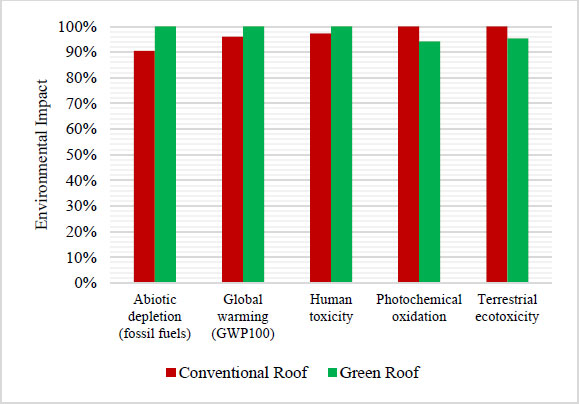
Comparison of the environmental impacts of the roofs under study according to the impact categories of fossil fuel depletion, global warming potential over 100 years, human toxicity, photochemical oxidation, and terrestrial ecotoxicity.
To complement the percentage-based comparison presented in Fig. (3), Table 7 presents the absolute values adopted in the environmental impact assessment, obtained for the selected impact categories through the calculation procedures performed in the openLCA® 2.0 software.
| Impact Categories | Unit | Mean Applied in the Research | Monte Carlo Simulation (1000 iterations) – Descriptive Analysis | ||||||
|---|---|---|---|---|---|---|---|---|---|
| Mean | Standard Deviation | Minimum | Maximum | Median | 5% Percentile | 95% Percentile | |||
| Abiotic depletion (fossil fuels) | MJ | 1242.13 | 1203.67 | 157.52 | 859.32 | 2372.08 | 1183.54 | 994.59 | 1480.07 |
| Global warming potential over 100 years (GWP100) | kg CO2 eq. | 140.27 | 137.44 | 16.81 | 98.62 | 211.80 | 135.37 | 112.52 | 168.49 |
| Human toxicity | kg 1.4-DB eq. | 81.20 | 6.83 | 15.30 | -39.87 | 127.98 | 5.67 | -12.11 | 29.54 |
| Photochemical oxidation | kg C2H4 eq. | 0.03 | 0.03 | 0.02 | 0.01 | 0.21 | 0.03 | 0.02 | 0.05 |
| Terrestrial ecotoxicity | kg 1.4-DB eq | 0.28 | 0.26 | 2.45 | -21.22 | 22.47 | 0.18 | -2.08 | 2.40 |
Source: prepared by the authors.
In addition, a statistical analysis was conducted using Monte Carlo simulation with 1000 iterations, allowing the estimation of descriptive statistical parameters such as mean, standard deviation, minimum and maximum values, median, and the 5% and 95% percentiles. The results of the Monte Carlo simulation are also presented in Table 7.
The Monte Carlo simulation results showed variability in the possible impact values, particularly due to the wide range between minimum and maximum simulated results, which also contributed to differences between the mean simulated values and the values adopted in the study. These results indicate potential inconsistencies associated with the uncertainty level of the adopted methodology. Nevertheless, future studies are encouraged to refine methodological assumptions in order to reduce uncertainties in the environmental assessment. Graphical representations of the Monte Carlo iteration results for each impact category are provided in the Supplementary Materials.
Similarly, Table 8 presents the absolute values adopted in the environmental impact assessment for the conventional roof system, as well as the descriptive statistical analysis obtained through Monte Carlo simulation with 1000 iterations.
| Impact Categories | Unit | Mean Applied in the Research | Monte Carlo Simulation (1000 iterations) – Descriptive Analysis | ||||||
|---|---|---|---|---|---|---|---|---|---|
| Mean | Standard Deviation | Minimum | Maximum | Median | 5% Percentile | 95% Percentile | |||
| Abiotic depletion (fossil fuels) | MJ | 1123.84 | 1091.56 | 166.07 | 736.89 | 2519.05 | 1074.47 | 884.24 | 1355.05 |
| Global warming potential over 100 years (GWP100) | kg CO2 eq. | 134.71 | 131.90 | 17.49 | 88.32 | 252.06 | 129.95 | 105.67 | 161.59 |
| Human toxicity | kg 1.4-DB eq. | 79.00 | 7.52 | 14.65 | -27.15 | 153.90 | 5.58 | -9.81 | 28.72 |
| Photochemical oxidation | kg C2H4 eq. | 0.04 | 0.03 | 0.01 | 0.02 | 0.21 | 0.03 | 0.02 | 0.05 |
| Terrestrial ecotoxicity | kg 1.4-DB eq | 0.29 | 0.21 | 2.38 | -26.35 | 22.80 | 0.28 | -1.76 | 2.46 |
Source: Prepared by the authors.
The Monte Carlo simulation results for the conventional roof also demonstrated some variability in the possible impact values, particularly in categories that presented a wide range between minimum and maximum simulated results. Nevertheless, the overall comparative analysis between the evaluated roofing systems remained generally consistent. The Supplementary Materials also include graphical representations of the Monte Carlo simulation results for all evaluated impact categories associated with the conventional roof system.
According to an operational guide for life cycle assessment by CML [32], terrestrial ecotoxicity refers to the potential impacts that toxic substances may cause when they come into contact with terrestrial ecosystems. Therefore, the slightly lower impacts observed for the green roof in this category may be related to the atmospheric pollutant removal potential associated with vegetation, as discussed in the study by Yang et al. [30]. The absorption of toxins from the atmosphere through filtration by vegetation can act as a barrier, preventing direct contact between toxic substances and the soil.
The photochemical oxidation impact category is related to the formation of reactive chemical compounds, such as ozone, due to the interaction of sunlight with certain primary atmospheric pollutants [32]. Ozone was part of the pollutants removed that were quantified for the use of the green roof over a 40-year period, which may have contributed to the slightly lower impacts observed in this category when compared to the impacts of the conventional roof.
In the categories of fossil fuel depletion, global warming potential over 100-years, and human toxicity, the green roof showed slightly higher impacts than the conventional roof, with increases of 10%, 4%, and 3%, respectively. These differences may be influenced by the greater quantity and complexity of material layers required for the green roof system, which can contribute to increased resource consumption and emissions during material production.
In the research by Bachawati et al. [33], the life cycle assessment conducted for an extensive green roof demonstrated results of environmental impact reduction, including for impact categories similar to those adopted in this study, such as terrestrial ecotoxicity. However, when evaluating an intensive green roof, characterized by higher material consumption, the observed impacts even exceeded those of conventional roofs. It is important to note that the authors had a different scope than the present study, using different materials as components of the green roof and disregarding the removal of pollutants with the use of the roof.
Similarly to what was observed in the present study, Pique et al. [34] report that green roofs may have higher impacts in the global warming potential category due to the large amount of materials required for their construction. Furthermore, the authors highlight that peak impact moments throughout the life cycle occur at the end of the green roof's life span, when the replacement of various components is necessary. However, conventional roofs also exhibit these peak impact moments, mainly due to the need for frequent maintenance, which, in the authors' study, resulted in total environmental impacts even higher than those of the green roof.
In the research by Bianchini and Hewage [1], it is reported that polyethylene and polypropylene present in the layers of the green roof have significant negative environmental impacts, resulting in uncertainty about the environmental performance of the green roof. This is because polymeric materials have a high pollution potential in their production process. Similarly, in the present study, the green roof showed slightly improved performance in specific impact categories, but it is still necessary to understand the severity of the negative impacts from the material production processes in the early periods.
In the research by Mihalakakou et al. [35], the benefits of the green roof were highlighted, such as air pollution removal, carbon sequestration, internal temperature regulation, and improvement of stormwater runoff quality. In life cycle assessments presented by the authors, a greater portion of good performance in impact reduction was observed, which partly differs from the results of the present study.
It is understood that the advantages of the green roof may become more evident over longer service life periods, during which its benefits can be utilized. In the case studied by Tams et al. [36], the green roof would need at least 53 years to neutralize the carbon dioxide emissions associated with its construction, which exceeds the typical useful life considered for this type of construction. Therefore, depending on the scope and the comparison made, the green roof can show positive environmental performance results, but the reuse or recycling of materials, as well as other ways to extend the useful life of this type of roof, may be essential for the feasibility of this kind of construction.
The main materials that contribute to the environmental impacts calculated for the assessed impact categories, expressed as a percentage of the total resulting impacts, are represented for the green and conventional roofs in Fig. (4).
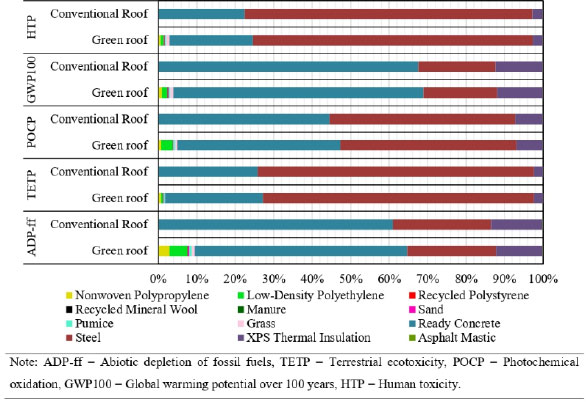
Percentage contribution of roof components to the impacts of the study categories.
A large portion of the impacts was associated with the materials of the support base, which were similar for both types of roofs. Ready-mix concrete showed the highest contribution percentages in the categories of abiotic depletion of fossil fuels and global warming potential over 100 years. Meanwhile, steel showed the highest contribution percentages in the other impact categories. It is evident that there is a need to explore options to reduce these impacts, such as the use of more sustainable concrete alternatives and reducing steel consumption.
As for the specific materials of the green roof, low-density polyethylene used in the root barrier is, in most impact categories, the most polluting material, followed by non-woven polypropylene from the protection and filtration layer. To achieve even lower impacts with these materials, one could explore possible alternative materials to replace them or evaluate whether the layers containing these materials are necessary for the green roof in the case of application.
The high impacts of polymer materials within the layers of the green roof align with the characteristics described by Bianchini and Hewage [1]. According to the authors, the methods used to produce polymers result in high energy consumption due to the increased temperature required to melt the raw materials and facilitate molding. Furthermore, they state that this energy and the chemicals used in the manufacturing process of the polymers release toxic substances into the air, which ultimately influences the environmental performance results, as observed in the present study.
As in the study by Chenani et al. [29], it was understood that simplified roof systems using recycled materials are the most environmentally suitable options. Based on some of the materials from the layers of green roofs analyzed by these authors, it was possible to perform a satisfactory comparative analysis with the conventional roof, demonstrating that the layers specific to the green roof do not contribute a higher percentage than the materials common to both types of roofs.
3.2. Results of the Green Roof Models Analysis
A life cycle assessment was carried out for variations of green roofs observed in the literature, in order to compare them with the extensive green roof addressed in this study. Table 9 presents the results for Extensive Green Roof A, including both the absolute values adopted in the comparative analysis between the roof models and the descriptive statistical analysis obtained through Monte Carlo simulation.
| Impact Categories | Unit | Mean Applied in the Research | Monte Carlo Simulation (1000 iterations) – Descriptive Analysis | ||||||
|---|---|---|---|---|---|---|---|---|---|
| Mean | Standard Deviation | Minimum | Maximum | Median | 5% Percentile | 95% Percentile | |||
| Abiotic depletion (fossil fuels) | MJ | 1507.75 | 1469.98 | 164.34 | 1139.34 | 2739.46 | 1450.04 | 1245.96 | 1736.60 |
| Global warming potential over 100 years (GWP100) | kg CO2 eq. | 139.69 | 136.39 | 17.19 | 96.51 | 240.18 | 134.86 | 111.63 | 166.46 |
| Human toxicity | kg 1.4-DB eq. | 84.80 | 5.11 | 15.17 | -34.16 | 142.68 | 3.21 | -14.07 | 27.81 |
| Photochemical oxidation | kg C2H4 eq. | 0.04 | 0.04 | 0.01 | 0.02 | 0.25 | 0.04 | 0.03 | 0.06 |
| Terrestrial ecotoxicity | kg 1.4-DB eq | 0.29 | 0.18 | 2.16 | -23.50 | 29.58 | 0.20 | -2.03 | 2.22 |
The environmental impact results obtained for Intensive Green Roofs A and B are presented in Tables 10 and 11, respectively, together with the descriptive statistical parameters derived from the Monte Carlo simulation performed for the selected impact categories.
| Impact Categories | Unit | Mean Applied in the Research | Monte Carlo Simulation (1000 iterations) – Descriptive Analysis | ||||||
|---|---|---|---|---|---|---|---|---|---|
| Mean | Standard Deviation | Minimum | Maximum | Median | 5% Percentile | 95% Percentile | |||
| Abiotic depletion (fossil fuels) | MJ | 1358.25 | 1337.93 | 55.57 | 1186.11 | 1533.88 | 1335.19 | 1250.81 | 1438.03 |
| Global warming potential over 100 years (GWP100) | kg CO2 eq. | 169.59 | 166.22 | 9.45 | 140.85 | 199.70 | 165.48 | 151.22 | 183.59 |
| Human toxicity | kg 1.4-DB eq. | 288.03 | 21.71 | 43.63 | -115.12 | 494.45 | 18.39 | -40.02 | 89.36 |
| Photochemical oxidation | kg C2H4 eq. | 0.05 | 0.04 | 0.01 | 0.03 | 0.10 | 0.04 | 0.03 | 0.06 |
| Terrestrial ecotoxicity | kg 1.4-DB eq | 1.08 | 1.14 | 4.04 | -14.87 | 26.71 | 1.12 | -5.12 | 7.42 |
| Impact Categories | Unit | Mean Applied in the Research | Monte Carlo Simulation (1000 iterations) – Descriptive Analysis | ||||||
|---|---|---|---|---|---|---|---|---|---|
| Mean | Standard Deviation | Minimum | Maximum | Median | 5% Percentile | 95% Percentile | |||
| Abiotic depletion (fossil fuels) | MJ | 2814.38 | 2760.22 | 183.74 | 2338.74 | 3735.57 | 2738.64 | 2490.95 | 3083.63 |
| Global warming potential over 100 years (GWP100) | kg CO2 eq. | 272.27 | 267.29 | 17.77 | 227.57 | 342.77 | 265.37 | 241.37 | 298.32 |
| Human toxicity | kg 1.4-DB eq. | 142.11 | -11.82 | 22.33 | -119.57 | 156.67 | -11.89 | -43.42 | 16.02 |
| Photochemical oxidation | kg C2H4 eq. | 0.06 | 0.06 | 0.02 | 0.04 | 0.47 | 0.05 | 0.04 | 0.08 |
| Terrestrial ecotoxicity | kg 1.4-DB eq | 0.46 | 0.26 | 3.24 | -48.87 | 18.96 | 0.29 | -3.69 | 4.28 |
The Monte Carlo simulation results for the evaluated green roof models demonstrated variability patterns similar to those observed for the roofing systems previously analyzed. In general, the mean simulated values remained relatively close to the absolute values adopted in the comparative assessment, particularly for the categories of abiotic depletion of fossil fuels and global warming potential. Greater variability was observed in categories such as human toxicity and terrestrial ecotoxicity, which presented wider ranges between minimum and maximum simulated values. These variations may be associated with uncertainties in the inventory data and calculation procedures adopted in the life cycle assessment. Despite the observed variability, the results still allowed a reasonably consistent comparative assessment between the evaluated roof systems. The Supplementary Materials provide graphical representations of the Monte Carlo simulation results for each impact category of each evaluated green roof model.
Figure 5 presents the results of the environmental impacts calculated for the impact categories of abiotic depletion of fossil fuels, terrestrial ecotoxicity, photochemical oxidation, global warming potential over 100 years, and human toxicity. The highest impact was established as the total value (100%), to be compared with the equivalent percentage of the other roofs.
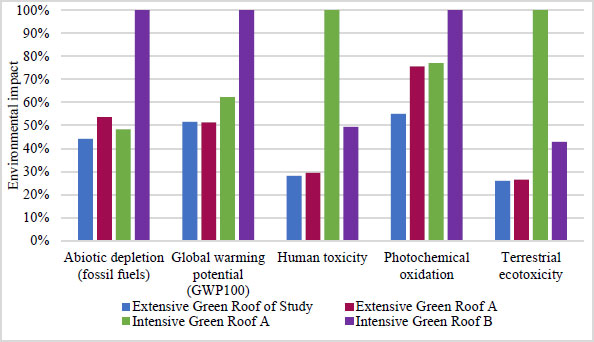
Environmental impact analysis of different green roof compositions found in the literature.
As observed, the green roof used in this study showed the lowest environmental impacts in all impact categories except for global warming potential over 100 years, where it had an impact just 0.2% higher than the Extensive Green Roof A. Therefore, in the comparison between extensive green roofs, it was noted that the materials selected for the inventory in this study performed well environmentally.
The comparison between the two extensive green roof models allowed for an exploratory assessment of the environmental performance associated with the selected material configurations. In this sense, the materials adopted based on the study by Chenani et al. [29], which served as a reference for the layers of the green roof evaluated in the present study, showed comparatively lower environmental impacts than the alternative roof model analyzed. As discussed by the authors, factors such as the reduction in material quantities, for example by decreasing the amount of sand in the substrate and increasing the proportion of pumice stone, as well as the use of recycled materials such as mineral wool in the water retention layer, may have contributed to these comparatively lower environmental impacts.
The intensive green roof options showed higher impacts than the extensive green roofs. The Intensive Green Roof A presented the highest impacts in the categories of terrestrial ecotoxicity and human toxicity. As observed in the contribution analysis, the steel in the supporting base of the roofs is the main element causing impacts in these two categories. This intensive roof requires a larger amount of steel than the others, needed to support the thicker substrate and larger vegetation of the intensive roof, which results in the highest impacts in the two categories.
For the Intensive Green Roof B, the highest impacts were observed in the categories of abiotic depletion of fossil fuels, photochemical oxidation, and global warming potential over 100 years. In this case, the impacts stem from the high consumption of resources required for the construction of this type of roof and, consequently, the emissions associated with the manufacturing of the roof layers.
These results are consistent with other studies that compared intensive and extensive green roofs [33] and [34], where, in general, the intensive green roof resulted in higher environmental impacts. Therefore, it is reinforced that the green roof with better environmental performance is the extensive green roof.
4. STUDY LIMITATIONS
This study has some limitations related to data availability and scope definition. The inventory data were primarily based on literature sources and adapted to the processes available in the Ecoinvent 3.6 database, which may not fully represent specific regional construction practices. In addition, installation processes, maintenance requirements, biodiversity benefits, and potential energy savings during operation were not included in the assessment. Maintenance activities and operational energy consumption were excluded due to the high variability associated with climatic conditions, building use patterns, and maintenance strategies. The results are also influenced by assumptions regarding vegetation type, service life, and system boundaries. Furthermore, the adoption of 1 m2 of roof area as the functional unit may have limited the representation of benefits associated with the use phase of green roofs. The use of the Ecoinvent 3.6 database may influence the absolute values of the calculated environmental impacts due to differences between database versions regarding electricity mixes, background processes, transportation datasets, and emission factors. In the Monte Carlo simulation, only the uncertainty associated with the background inventory, derived from the Ecoinvent database, was considered in the analysis, while foreground inventory uncertainty was not included and should be addressed in future studies. Nevertheless, since the same database version was consistently applied to all evaluated scenarios, the comparative interpretation between the roofing systems is considered methodologically consistent. Future studies should incorporate primary data, adopt cradle-to-grave approaches, and more recent versions of the Ecoinvent database to provide a more comprehensive evaluation of green roof performance.
CONCLUSION
The environmental life-cycle assessment of the green roof was carried out based on impact categories in comparison to a conventional flat roof. Only in the categories of terrestrial ecotoxicity and photochemical oxidation did the green roof show reduced impacts compared to the conventional roof, with reductions of 5% and 6%, respectively. These differences may be partially related to the vegetation's ability on the green roof to remove pollutants from the atmosphere, which was accounted for in the life-cycle assessment conducted.
Regarding the other impact categories assessed, increases in environmental impacts were observed with the use of the green roof compared to the conventional roof. Increases of 10% were noted for the category of abiotic depletion of fossil fuels, 4% for the 100-year global warming potential, and 3% for human toxicity. These increases in impact can be attributed to the scope defined for the life cycle assessment and also to the fact that the green roof involves a greater quantity and complexity of material layers used in its construction.
However, it is important to note that previous studies have reported potential long-term environmental benefits associated with green roofs, particularly regarding improvements in air quality and thermal comfort in urban environments. In addition, green roofs may contribute to reductions in building energy consumption due to their thermal insulation properties, although these aspects were not assessed in the present study.
The materials that contributed most to the environmental impacts were, in general, ready-mix concrete and steel, used in the structural base of both the green roof and the conventional roof. Based on this analysis, it is important to pay attention to the selection of environmentally appropriate materials for the roof layers, seeking alternatives that reduce the use of the most polluting materials.
In addition, a life cycle assessment of different green roof models was conducted to compare the extensive green roof addressed in this study with another extensive green roof and two intensive green roofs analyzed in studies by other authors. It was observed that the extensive green roof results in lower environmental impacts than the intensive green roof. The green roof evaluated in the present study showed comparatively lower environmental impacts among the compared roof models, suggesting that the selected material configuration may contribute to improved environmental performance within the adopted assessment scope.
As a recommendation for future work, it is suggested that the energy efficiency of the green roof be investigated by comparing its thermal insulation capacity with that of a conventional roof and analyzing the implications of this difference for environmental impacts.
AUTHORS’ CONTRIBUTIONS
The authors confirm contribution to the paper as follows: N.K.S.T: Study conception and design; N.K.S.T, S.S.M.C: Data collection; N.K.S.T, S.S.M.C, M.D.L: Analysis and interpretation of results; N.K.S.T, M.D.L., M.S.E.L, S.T.A. and C.I.M.: Draft manuscript. All authors reviewed the results and approved the final version of the manuscript.
LIST OF ABBREVIATIONS
| ADPF | = Abiotic Depletion of Fossil Fuels |
| BR | = Brazil |
| C2H4 | = Ethylene |
| CO2 | = Carbon Dioxide |
| DB | = Dichlorobenzene |
| GLO | = Global |
| GtCO2 | = Gigatons of Carbon Dioxide |
| GWP100 | = Global Warming Potential over 100 years |
| HTP | = Human Toxicity |
| LCA | = Life Cycle Assessment |
| NO2 | = Nitrogen Dioxide |
| O3 | = Ozone |
| PM10 | = Particulate Matter 10 Micrometers or Smaller |
| POCP | = Photochemical Oxidation |
| RoW | = Rest of the World |
| SO2 | = Sulfur Dioxide |
| TETP | = Terrestrial Ecotoxicity |
| U | = Unity Process |
AVAILABILITY OF DATA AND MATERIALS
The data supporting the findings of this study are available from the corresponding author [I.C.], upon request.
FUNDING
This research was financed by the Coordenação de Aperfeiçoamento de Pessoal de Nível Superior – Brazil (CAPES) and Fundação de Amparo à Pesquisa e ao Desenvolvimento Científico e Tecnológico do Maranhão -Brazil (FAPEMA) (Process APP-02399/25).
ACKNOWLEDGEMENTS
The authors express their gratitude to the Coordenação de Aperfeiçoamento de Pessoal de Nível Superior - Brazil (CAPES) for providing financial support for this research, as well as to the Programa de Pós Graduação em Engenharia Civil e Ambiental at the Universidade Estadual de Feira de Santana (UEFS) and the Unidade de Investigação em Governação, Competitividade e Políticas Públicas (GOVCOPP), Universidade de Aveiro, Portugal. The authors have reviewed and edited the output and take full responsibility for the content of this publication.