All published articles of this journal are available on ScienceDirect.

Mechanical and Thermal Performance of LDPE-modified Fly Ash–GGBS Geopolymer Mortars for Sustainable Building Applications

Abstract
Introduction
Environmental problems are becoming increasingly prevalent in the construction industry, mainly due to the significant carbon emissions associated with Ordinary Portland Cement (OPC) production and the growing accumulation of non-biodegradable plastic waste. In this context, the present study focuses on the use of discarded Low-Density Polyethylene (LDPE) as a partial replacement for fine aggregate in geopolymer mortars.
Methods
Three distinct binder systems were considered: fly ash-based Geopolymer Mortar (GPM), blended Fly ash–GGBS Geopolymer Mortar (FG), and traditional OPC mortar, with LDPE replacement levels ranging from 0% to 50%. The experimental investigation was carried out to evaluate compressive strength, thermal properties including thermal conductivity and specific heat capacity, and dynamic thermal parameters such as time lag (φ) and decrement factor (f).
Results
The results showed that as the LDPE content increased, the thermal performance of all mixtures consistently improved, while the compressive strength gradually decreased. The fly ash–GGBS blended geopolymer mortar with 50% LDPE showed better thermal performance among all the mixtures, with a low thermal conductivity of 0.29 W/m·K, a decrement factor of 0.029, and a time lag of approximately 4.10 hours.
Discussion
The inclusion of LDPE improved internal porosity, which reduced thermal conductivity and enhanced dynamic thermal performance. This demonstrates the ability of fly ash–GGBS geopolymer mortar to maintain a balance between mechanical strength and thermal insulation.
Conclusion
These findings suggest that LDPE-incorporated geopolymer mortars, especially fly ash–GGBS-based systems, can serve as energy-efficient and sustainable alternatives for non-structural building envelope applications.
1. INTRODUCTION
The construction sector is an important industry in developing countries, where cement production contributes roughly 7–8% of global CO2 emissions and environmental degradation [1-4]. In addition, the increasing accumulation of non-biodegradable plastic waste contributes to landfill burdens and environmental contamination [5]. LDPE waste from consumer goods and packaging is increasing in India, along with large amounts of industrial by-products such as Fly Ash (FA) from thermal power plants and Ground Granulated Blast-furnace Slag (GGBS) from steel production [6, 7]. The construction industry must adopt sustainable binders and promote waste valorization strategies in response to rising carbon emissions from cement production, plastic waste accumulation, and inefficient utilization of industrial waste [8]. Geopolymer technology is a low-carbon alternative to OPC that uses aluminosilicate-rich industrial waste activated with alkaline solutions to generate durable, cement-free matrices [9-11]. According to life-cycle estimates, geopolymer concretes can reduce CO2 emissions by up to 80% compared to OPC systems [12, 13]. When calcium-rich GGBS is added to FA-based systems, hybrid gel formation involving sodium aluminosilicate hydrate (N–A–S–H) and calcium aluminosilicate hydrate (C–A–S–H) is promoted [14-16]. These gels improve mechanical resistance and thermal stability by refining pore structures, enabling ambient curing, and increasing early-age strength [17-19]. Due to their chemical durability and thermal performance, these FA–GGBS binders have shown strong potential for low-energy construction in tropical regions [20]. Similarly, waste plastics can be used as partial replacements for fine aggregates to produce lightweight and thermally efficient composites [21-23]. Due to its low density and thermal conductivity, LDPE reduces solid-phase heat transfer and improves insulation [24, 25]. However, its weak interfacial bonding and hydrophobic surface reduce compressive strength, creating a trade-off between mechanical integrity and thermal insulation. Recent studies on recycled plastics, including PVC, PET, and LDPE, in geopolymer matrices have reported strength losses and reductions in thermal conductivity of up to 40% [26, 27]. However, most studies focus mainly on static properties and give limited attention to dynamic thermal behavior [28, 29]. Dynamic thermal characteristics, namely decrement factor (f) and time lag (ϕ), govern the damping and delay of temperature variations across building envelopes, directly influencing indoor comfort and energy efficiency. However, limited studies have evaluated these parameters for different LDPE replacement levels in FA–GGBS geopolymers. Hybrid binder systems can potentially offset strength reductions caused by polymer inclusion through microstructural densification, but their behavior under real climatic cycles remains underexplored [15, 30]. This study examines the mechanical and thermal behavior of three mortar systems—fly ash-based Geopolymer Mortar (GPM), Fly ash–GGBS-blended Geopolymer Mortar (FG; 65% FA + 35% GGBS), and OPC reference mortar—with LDPE waste partially substituting manufactured sand at 0–50% by weight. By combining static (compressive strength, thermal conductivity, and specific heat capacity) and dynamic (decrement factor and time lag) evaluations, this work establishes LDPE-modified FA–GGBS geopolymers as low-carbon and thermally efficient materials for non-structural building-envelope applications.
2. MATERIALS AND METHODS
2.1. Materials
The materials used in the present study were from local and industrial sources, and both chemical and physical properties were evaluated in accordance with applicable Indian Standards. The mortar composites were made with Aluminosilicate binders, fine aggregates, waste plastic, and alkaline activators.
2.1.1. Fly Ash
The Raichur Thermal Power Station in Karnataka was the source of Class F fly ash shown in Fig. (1). Most fly ash particles were spherical and had an average size of less than 45 µm. A specific gravity of 2.01 was obtained using the density bottle method. Table 1 shows the chemical composition of fly ash, which indicates that it is suitable for geopolymerization because it is low in calcium oxide and high in silica and alumina [30].
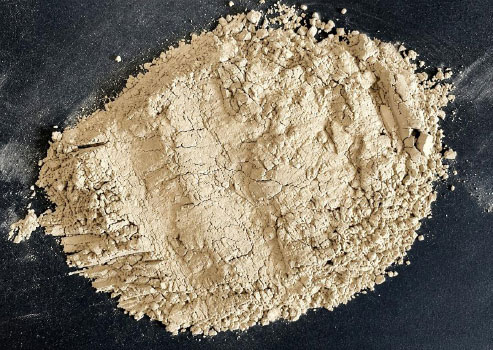
Fly ash used in the present study.
| Chemical Composition | Fly Ash, (Class F) Wt % |
|---|---|
| Silica (SiO2) | 62 |
| Alumina (Al2O3) | 20 |
| Ferric Oxide (Fe2O3) | 2.3 |
| Calcium Oxide (CaO) | 2 |
| Magnesium Oxide(MgO) | 0.9 |
| Sulfate Oxide (SO3) | 0.75 |
| Loss of ignition | 1.8 |
2.1.2. Granulated Blast Furnace Slag (GGBS)
GGBS meets the IS 12089 criteria and was obtained from JSW Steel in Toranagallu, Karnataka, as shown in Fig. (2). The slag exhibited good reactivity, with a specific gravity of 2.85 and a high glass content of nearly 92%. Table 2 provides a full summary of GGBS's oxide composition. When combined with fly ash, the comparatively high CaO level of GGBS improved early-age strength and allowed ambient curing [31].
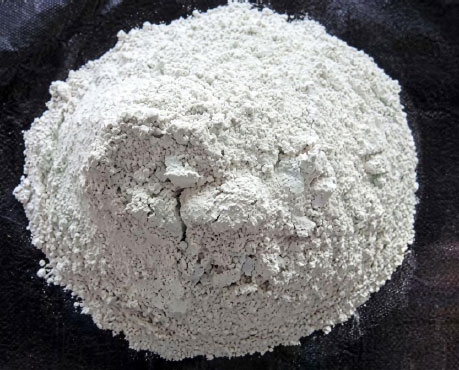
GGBS used in the present study.
| Parameters | Results in % |
|---|---|
| CaO | 37.34 |
| Al2O3 | 14.42 |
| Fe2O3 | 1.11 |
| SiO2 | 37.73 |
| MgO | 8.71 |
| MnO | 0.002 |
| Sulphide sulphur | 0.39 |
| Loss of ignition | 1.41 |
| Insoluble Residue | 1.59 |
| Glass content | 92 |
2.1.3. Fine Aggregates
Manufactured sand (M-sand) was used as the fine aggregate and conforms to IS 383. The specific gravity of 2.52, a fineness modulus of 2.6, and a water absorption of 7.1% confirm its suitability for mortar [32, 33]. Comparison of particle size distribution of M-sand and LDPE waste plastic is shown in Fig. (3). The LDPE waste plastic used in this study was collected from a local plastic recycling unit. Crushed and powdered LDPE from a plastic recycling unit in Peenya, Bengaluru, was used as waste plastic in this investigation. In comparison to M-sand, the LDPE, which was made from used bottles, caps, and containers, had a lower specific gravity (0.94) and fineness modulus (1.94). Due to surface roughness and entrapped air in the particles, which were taken into consideration during mix proportioning, the LDPE had a water absorption of roughly 15%. It is anticipated that the reduced density and finer grading of LDPE may increase internal porosity in the mortar matrix, thereby affecting both mechanical strength and thermal performance.
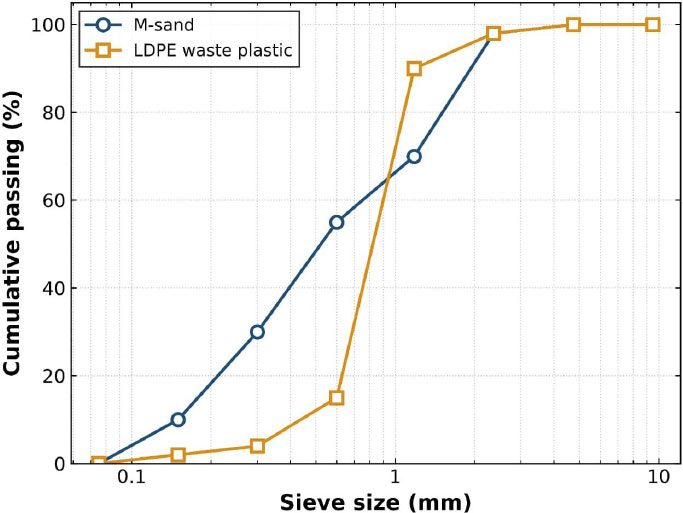
Comparison of particle size distribution of M-sand and LDPE waste plastic.
2.1.4. Alkaline Activators
Solutions of sodium hydroxide (NaOH) and sodium silicate (Na2SiO3) were used as alkaline activators in this study. Analytical-grade NaOH pellets were dissolved in potable water to prepare a 14 M NaOH solution, which was allowed to stabilize for 24 hours before use to ensure complete dissolution and thermal equilibrium. The silicate source used was a commercial sodium silicate solution with a silica modulus (SiO2/Na2O) of 2.74. Before casting, the NaOH and Na2SiO3 solutions were mixed in predetermined proportions and allowed to cool to room temperature. The blended activator was used for effective activation of fly ash and GGBS, and its composition was kept constant for all geopolymer mixes to maintain consistency and reproducibility.
2.2. Mix Design and Sample Preparation
Three types of mortar mixes were created: (i) GPM, (ii) FG, which contained 65% fly ash and 35% GGBS, and (iii) OPC mortar as the reference system. The fine aggregate in all mixes was M-sand in accordance with IS 383:2016, which was partially replaced with LDPE waste plastic at weight replacement levels of 0%, 10%, 20%, 30%, 40%, and 50%. The final optimum alkaline liquid-to-binder ratio of 0.72 was selected based on workability tests conducted using the flow table method as per IS 5512:1983. Several trial mixes with alkaline liquid-to-binder ratios of 0.45, 0.50, 0.60, 0.70, and 0.72 were carried out. Among these, the ratios of 0.70 and 0.72 showed better workability. However, a ratio of 0.72 was selected as optimal because it provided sufficient workability without requiring excessive amounts of superplasticizer.
After finalizing the optimum alkaline liquid-to-binder ratio, the binder–aggregate proportions for OPC mortar were adopted in accordance with IS 2250:1981 to ensure comparative evaluation. In compliance with IS 4031 (Parts 6 and 7), mortar specimens were cast in cube moulds of size 70.6 × 70.6 × 70.6 mm. The final mix proportions for all mortar variations, including binder composition, water content, activator dosage, LDPE replacement level, and curing regime, are presented in Tables 3 and 4.
| Binder system | Mix | M-sand (g) | LDPE plastic (g) | Fly ash (g) | GGBS (g) | Cement (g) |
|---|---|---|---|---|---|---|
| Geopolymer mortar (GPM) | GPM-0 | 600 | 0 | 116.27 | – | – |
| GPM-10 | 540 | 22.38 | 116.27 | – | – | |
| GPM-20 | 480 | 44.76 | 116.27 | – | – | |
| GPM-30 | 420 | 67.14 | 116.27 | – | – | |
| GPM-40 | 360 | 89.52 | 116.27 | – | – | |
| GPM-50 | 300 | 111.9 | 116.27 | – | – | |
| Blended geopolymer mortar (FG) | FG-0 | 600 | 0 | 75.57 | 40.69 | – |
| FG-10 | 540 | 22.38 | 75.57 | 40.69 | – | |
| FG-20 | 480 | 44.76 | 75.57 | 40.69 | – | |
| FG-30 | 420 | 67.14 | 75.57 | 40.69 | – | |
| FG-40 | 360 | 89.52 | 75.57 | 40.69 | – | |
| FG-50 | 300 | 111.9 | 75.57 | 40.69 | – | |
| OPC mortar | OPC-0 | 600 | 0 | – | – | 116.27 |
| OPC-10 | 540 | 22.38 | – | – | 116.27 | |
| OPC-20 | 480 | 44.76 | – | – | 116.27 | |
| OPC-30 | 420 | 67.14 | – | – | 116.27 | |
| OPC-40 | 360 | 89.52 | – | – | 116.27 | |
| OPC-50 | 300 | 111.9 | – | – | 116.27 |
| Binder System | Mix | Na2SiO3 (g) | NaOH (g) | Extra Water (g) | Alkaline Liquid/Binder | Curing Regime |
|---|---|---|---|---|---|---|
| Geopolymer mortar (GPM) | GPM-0 | 59.81 | 23.92 | 42 | 0.72 | Heat (75 °C, 24 h) |
| GPM-10 | 59.81 | 23.92 | 37.8 | 0.72 | Heat | |
| GPM-20 | 59.81 | 23.92 | 33.6 | 0.72 | Heat | |
| GPM-30 | 59.81 | 23.92 | 29.4 | 0.72 | Heat | |
| GPM-40 | 59.81 | 23.92 | 25.2 | 0.72 | Heat | |
| GPM-50 | 59.81 | 23.92 | 21 | 0.72 | Heat | |
| Blended geopolymer mortar (FG) | FG-0 | 59.81 | 23.92 | 42 | 0.72 | Ambient |
| FG-10 | 59.81 | 23.92 | 37.8 | 0.72 | Ambient | |
| FG-20 | 59.81 | 23.92 | 33.6 | 0.72 | Ambient | |
| FG-30 | 59.81 | 23.92 | 29.4 | 0.72 | Ambient | |
| FG-40 | 59.81 | 23.92 | 25.2 | 0.72 | Ambient | |
| FG-50 | 59.81 | 23.92 | 21 | 0.72 | Ambient | |
| OPC mortar | OPC-0 | – | – | 125.73 | – | Water |
| OPC-10 | – | – | 121.53 | – | Water | |
| OPC-20 | – | – | 117.33 | – | Water | |
| OPC-30 | – | – | 113.13 | – | Water | |
| OPC-40 | – | – | 108.93 | – | Water | |
| OPC-50 | – | – | 104.73 | – | Water |
To assess the effect of calcium-rich slag on ambient geo-polymerization, GPM specimens were heat-cured at 75°C for 24 hours, while FG specimens were cured under ambient laboratory conditions. In accordance with IS 516:2018, OPC specimens were water-cured. After 28 days of curing, each specimen was examined [34-36].
2.3. Experimental Program
2.3.1. Compressive Strength
In compliance with IS 516:2018, the compressive strength of mortar specimens was measured after 28 days using a calibrated compression testing machine. Cubical specimens measuring 70.6 × 70.6 × 70.6 mm were subjected to monotonic compressive loading until failure. To ensure accuracy and reduce experimental variability, three specimens were tested for each mix, and the average compressive strength was reported. This testing method has been widely used and validated in prior research, demonstrating consistent, reproducible results for geopolymer systems under ambient curing conditions [37, 38].
2.3.2. Thermal Conductivity
Thermal conductivity was tested using a transient hot-wire method suitable for low-conductivity cementitious and geopolymer materials. A 20-gauge nichrome wire, which served as a linear heat source, was positioned 2 mm away from a K-type thermocouple. The wire–thermocouple system was placed between two identical mortar specimens while a constant direct current was supplied. The temperature rise was monitored at intervals from 5 seconds to 150 seconds, and the thermal conductivity (λ) was computed using the transient heat conduction model.
The transient hot-wire method has gained popularity in polymer-modified and geopolymer composites due to its accuracy and reliability in assessing low-conductivity materials. This method ensures accurate real-time heat-response measurements and has been effectively used and experimentally validated for thermal conductivity assessment in heterogeneous systems, especially waste-polymer-modified geopolymer mortars [38].
2.3.3. Specific Heat Capacity
A modified half-open dynamic calorimetric method was used to determine the specific heat capacity (Cp) of the mortar based on energy balance principles. The custom testing setup, shown in Fig. (4), consisted of a 5-liter container. Thick exterior insulation was wrapped around the container to prevent heat loss. A K-type thermocouple was passed through the lid and connected to a digital multimeter (±0.1°C resolution) to monitor the internal water temperature.
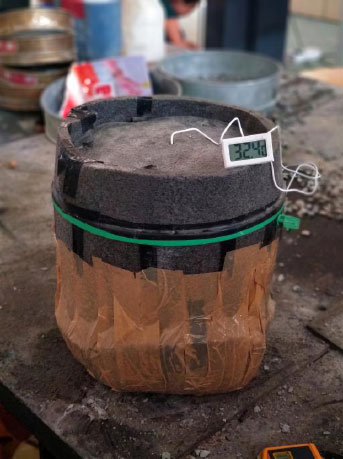
Experimental arrangements for determination of specific heat capacity.
To start the procedure, 3 liters of room-temperature water were poured into the insulated container, and the initial temperature (T0) was recorded. The dry Mortar block (Mb) was weighed separately and placed inside a heating furnace. An infrared thermal laser gun was used to check when the block reached a uniform temperature of 65°C. Once heated, the block was quickly submerged into the water bath. As the hot specimen released its stored heat, the water temperature was recorded manually at 5-minute intervals. These readings continued until the water reached its maximum temperature (T2) and started to cool, indicating thermal equilibrium.
The mortar’s specific heat (Cpᵦ) was calculated using the standard thermal energy balance equation based on the principle of conservation of energy.
Here, Mw represents the water mass, and Cpʷ is the specific heat of water. ΔTb represents the temperature drop of the specimen (Tinitial – T2), and ΔTw represents the temperature rise of water (T2 – T0). The thermal mass of the container was considered negligible due to the exterior insulation and the large volume of water used. To ensure accuracy, the test was repeated on three specimens for each mix design.
2.3.4. Dynamic Thermal Characteristics
A one-dimensional transient heat conduction model based on the heat diffusion equation was developed and implemented in Scilab to study the dynamic thermal response of the mortar specimens. Density, thermal conductivity, and specific heat capacity—properties determined through experimentation—were used as input parameters in the model, and diurnal conditions were simulated by applying periodic temperature fluctuations.
With this framework, the model was used to predict important dynamic thermal characteristics such as time lag (φ) and decrement factor (f). A resistance–capacitance–resistance (R–C–R) network was used to simulate heat transfer across the mortar section, thereby enabling measurement of heat-flow attenuation and delay. The R–C–R circuit model used for evaluating the decrement factor and time lag is shown in Fig. (5).
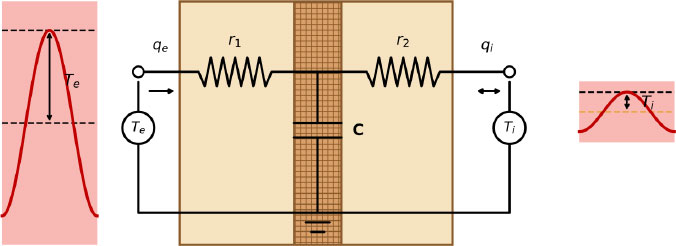
R–C–R circuit model used for evaluating decrement factor and time lag.
The model accurately predicts the thermal behavior of the prepared mortars under cyclic conditions, as evidenced by the good agreement between the predicted results and experimental trends [39].
3. RESULTS
3.1. Compressive Strength
Fig. 6 shows the variation in compressive strength of GPM, FG, and OPC mortars with increasing LDPE replacement. Across all binder systems, compressive strength decreased as LDPE content increased. For OPC mortar, the strength decreased from 18.92 MPa in the control mix to 12.00 MPa at 10% LDPE replacement and further decreased to 5.53 MPa at 50% replacement. A similar trend was observed in GPM, with strength decreasing from 12.09 MPa to 7.93 MPa at 50% replacement. Among all the mixes, the FG system showed better strength retention. Even though the strength decreased from 31.16 MPa in the control mix, the FG-50 mix still maintained 11.31 MPa at the highest LDPE replacement level. The error bars shown in Fig. (6) represent the standard deviation obtained from three replicate specimens, indicating the variation in the measured compressive strength values. The reduction in compressive strength may be mainly due to the weak bonding between LDPE particles and the surrounding mortar matrix. Since LDPE is hydrophobic in nature, it does not bond properly with the geopolymer gel or cement hydration products. In addition, the smooth surface of LDPE particles reduces mechanical interlocking and leads to the formation of voids inside the matrix. Under loading, these voids act as weak zones and initiate cracks at an earlier stage, which finally reduces the strength. Similar reductions in strength with plastic aggregate replacement have been reported in earlier studies [40]. In the present study, the fly ash–GGBS blended geopolymer mixes showed better performance than the OPC and fly ash-only mixes. This may be due to the combined formation of C–A–S–H and N–A–S–H gel phases, which made the matrix denser and improved load transfer even at higher LDPE content.
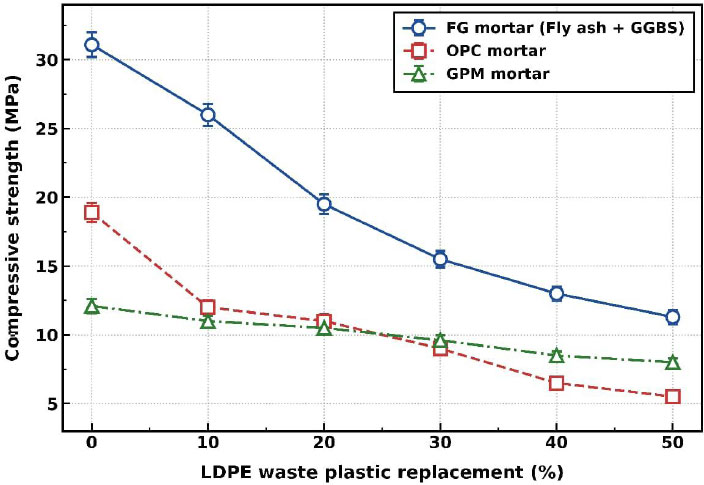
Effect of LDPE waste plastic replacement on 28-day compressive strength of mortar mixes. The x-axis represents the LDPE waste replacement percentage (0% to 50%), and the y-axis represents the compressive strength measured in Megapascals (MPa). Error bars represent the standard deviation.
3.2. Thermal Conductivity
Fig. 7 shows the variation in thermal conductivity of GPM, FG, and OPC mortars with different LDPE replacement levels. It can be observed that the thermal conductivity decreased with increasing LDPE content for all the binder systems. In OPC mortar, the thermal conductivity decreased from 0.6422 W/m·K for the control mix to 0.3680 W/m·K with a 50% LDPE replacement [40]. A similar trend was observed in the geopolymer mixes. For GPM, the value decreased from 0.5898 W/m·K to 0.3279 W/m·K at 50% replacement. The FG mixes showed lower thermal conductivity than the GPM and OPC mixes at all replacement levels, with the value decreasing from 0.5215 W/m·K to 0.2885 W/m·K.
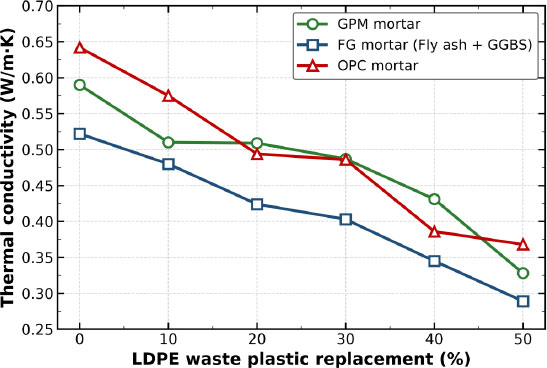
Variation of thermal conductivity with LDPE waste plastic replacement for geopolymer and OPC mortar systems. The x-axis denotes the percentage of LDPE waste replacement, and the y-axis indicates the thermal conductivity in W/m·K.
The reduction in thermal conductivity can be attributed mainly to two factors [40]. First, LDPE has a lower thermal conductivity compared to natural fine aggregate. When it replaces sand, it reduces the overall heat transfer through the mortar. Second, the hydrophobic nature of LDPE leads to poor bonding with the surrounding matrix and increases the formation of voids. These voids are generally filled with air, which has very low thermal conductivity, thereby reducing heat transfer further. Similar observations have been reported in earlier studies [41]. In the present study, the fly ash–GGBS blended geopolymer mixes showed better thermal insulation compared to OPC and fly ash-only mixes. This may be due to denser matrix formation by the combined C–A–S–H and N–A–S–H gel phases, which helped maintain structural stability and improve thermal resistance.
3.3. Specific Heat Capacity
The specific heat capacity of GPM, FG, and OPC mortars varied with increasing LDPE waste plastic content, as shown in Fig. (8). The specific heat capacity of GPM increased by almost 20%, from 1750 J/kg·K in the control mix to around 2100 J/kg·K at 50% LDPE replacement. This increase was attributed to the relatively higher heat capacity of LDPE, as well as the presence of small internal voids that delayed heat transfer and provided temporary energy storage [42, 43]. The FG mixes showed a similar trend, with a 25% increase in specific heat capacity from 1650 J/kg·K to 2200 J/kg·K. The enhanced performance was attributed to the hybrid gel structure (C–A–S–H and N–A–S–H), which improved matrix homogeneity and optimized the pore structure, thereby facilitating higher heat absorption [15, 43].
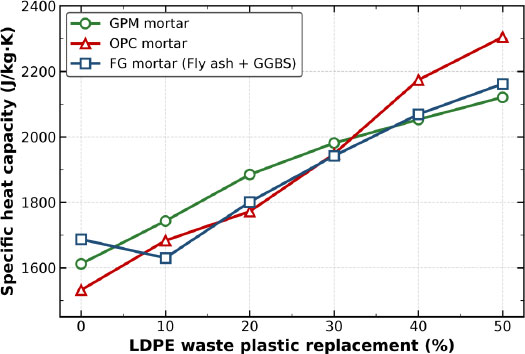
Variation of specific heat capacity with LDPE waste plastic replacement for geopolymer and OPC mortar systems. The x-axis shows the LDPE replacement percentage, while the y-axis represents the specific heat capacity measured in J/kg·K.
OPC mortar demonstrated the largest overall increase, with specific heat capacity increasing by almost 45%, from 1600 J/kg·K in the control mix to 2350 J/kg·K at 50% LDPE replacement. This behavior was attributed to the combined effects of LDPE particles and trapped air voids, which contributed to localized heat storage within the matrix. Nevertheless, geopolymer systems showed advantages in terms of long-term durability and reduced embodied carbon, even with higher specific heat values [44].
3.4. Dynamic Thermal Behavior
The dynamic thermal behavior of the mortar composites was assessed using decrement factor (f) and time lag (φ), which show how much the temperature wave is reduced and delayed as it passes through the material under cyclic thermal conditions [44]. Fig. 9 shows the variation of decrement factor (f) and time lag (φ) with LDPE content for the different binder systems. The dynamic thermal response was evaluated using a one-dimensional transient heat transfer model developed in SciLab based on a resistance–capacitance–resistance (R–C–R) network for a 200 mm thick wall section. Experimentally measured properties, including density, thermal conductivity (λ), and specific heat capacity (cₚ), were used as input parameters. The model considered an internal convective resistance of 0.13 m2K/W and a sinusoidal external temperature variation of 10°C over a 24-hour cycle [45, 46]. For all mixes, the decrement factor decreased as LDPE content increased, indicating improved attenuation of heat flow [47]. The FG mixes showed the lowest values among all mixes. The decrement factor reduced from 0.165 for the control mix (FG-0) to 0.029 at 50% LDPE replacement (FG-50). In comparison, the values for OPC-50 and GPM-50 were approximately 0.050 and 0.046, respectively. At the same time, the time lag increased with increasing LDPE content. For the FG mixes, the time lag increased from 0.435 hours for the control mix (FG-0) to 4.097 hours at 50% LDPE replacement (FG-50). The corresponding time-lag values for GPM-50 and OPC-50 were 2.874 hours and 2.102 hours, respectively, which were lower than those for the FG-50 mixes [47]. Overall, the FG mixes exhibited lower decrement factors and higher time-lag values than the other binder systems, indicating improved dynamic thermal performance under cyclic conditions.
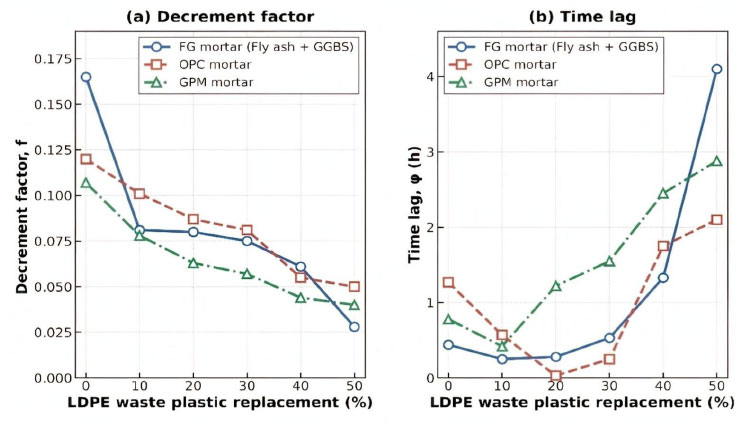
Combined variation of decrement factor and time lag with LDPE waste plastic replacement for all evaluated binder systems (FG, OPC, and GPM). The x-axis represents the LDPE replacement percentage. The primary y-axis (left) shows the dimensionless decrement factor (f), and the secondary y-axis (right) displays the time lag in hours.
A consolidated summary of the key mechanical and thermal properties of all mortar systems across different LDPE replacement levels is presented in Table 5 for ease of comparison.
| Waste Plastic (%) | Mix | Compressive Strength (MPa) | Thermal Conductivity (W/m·K) | Specific Heat Capacity (J/kg·K) | Decrement Factor (f) | Time Lag (h) |
|---|---|---|---|---|---|---|
| 0 | GPM | 12.09 | 0.5898 | 1611.48 | 0.106 | 0.783 |
| FG | 31.16 | 0.5215 | 1687.10 | 0.165 | 0.435 | |
| OPC | 18.92 | 0.6422 | 1528.60 | 0.120 | 1.252 | |
| 10 | GPM | 11.00 | 0.5102 | 1742.05 | 0.077 | 0.415 |
| FG | 26.00 | 0.4813 | 1631.11 | 0.081 | 0.230 | |
| OPC | 12.00 | 0.5754 | 1682.33 | 0.101 | 0.589 | |
| 20 | GPM | 10.50 | 0.5087 | 1884.49 | 0.063 | 1.222 |
| FG | 19.50 | 0.4237 | 1800.26 | 0.080 | 0.269 | |
| OPC | 11.00 | 0.4943 | 1772.24 | 0.086 | 0.020 | |
| 30 | GPM | 9.50 | 0.4870 | 1978.45 | 0.057 | 1.548 |
| FG | 15.50 | 0.4039 | 1941.34 | 0.075 | 0.542 | |
| OPC | 9.00 | 0.4863 | 1948.51 | 0.081 | 0.259 | |
| 40 | GPM | 8.50 | 0.4311 | 2051.93 | 0.045 | 2.460 |
| FG | 13.00 | 0.3462 | 2068.44 | 0.061 | 1.334 | |
| OPC | 6.50 | 0.3867 | 2172.37 | 0.055 | 1.730 | |
| 50 | GPM | 7.93 | 0.3279 | 2118.84 | 0.041 | 2.874 |
| FG | 11.31 | 0.2885 | 2161.86 | 0.029 | 4.097 | |
| OPC | 5.53 | 0.3680 | 2304.68 | 0.050 | 2.102 |
4. DISCUSSION
The observed reduction in compressive strength across all binder systems is primarily attributed to weak interfacial bonding between LDPE particles and the surrounding matrix. The hydrophobic nature and low stiffness of LDPE reduce the efficiency of stress transfer and promote the formation of microcracks under loading conditions [21, 26]. Despite this, geopolymer systems—particularly the fly ash–GGBS blend—exhibited relatively better strength retention. This improved strength retention likely stems from the C–A–S–H and N–A–S–H gels, as they help densify the matrix and form stronger internal bonds [14, 15, 18, 37]. Lower thermal conductivity at higher LDPE dosages happens for two main reasons: the plastic itself transfers very little heat, and mixing it in traps small air voids. Because these trapped voids disrupt the solid network required for heat to flow, they essentially act as roadblocks that enhance the material's overall insulating power [31, 48]. The increase in specific heat capacity can be attributed to the higher heat storage capacity of LDPE and the presence of internal porosity, which contributes to delayed heat transfer and enhanced thermal inertia [42, 43]. The dynamic thermal behavior further supports these findings. The decrease in decrement factor and increase in time lag with higher LDPE content indicate improved thermal damping and delayed heat transmission. The FG mixes, in particular, demonstrated superior performance due to their optimized pore structure and balanced thermal properties [47]. Overall, the combined reduction in heat transfer and enhancement in heat storage demonstrate the potential of LDPE-modified fly ash–GGBS mortars for thermally efficient and sustainable building applications [49].
5. STUDY LIMITATIONS
The present study demonstrates the potential of LDPE-modified geopolymer mortars for sustainable and thermally efficient construction applications. However, the following limitations should be noted:
- The study mainly focused on compressive strength and thermal performance. Other mechanical properties such as flexural strength, tensile strength, and modulus of elasticity were not investigated.
- The thermal analysis was based on a one-dimensional numerical model under idealized cyclic conditions. Actual field conditions may involve more complex heat transfer mechanisms.
- Only one type of processed LDPE waste and a single particle gradation were considered. Different plastic types, sizes, and shapes may influence mortar behavior in different ways.
- Microstructural characterization using SEM, XRD, and FTIR was not performed, which could have provided a better understanding of geopolymer gel formation and interfacial bonding.
Future studies may focus on:
- Long-term durability properties such as sorptivity, acid resistance, sulphate resistance, and freeze–thaw behavior.
- Large-scale wall testing under actual environmental exposure.
- Multi-dimensional thermal analysis for a better understanding of real-time heat transfer behavior.
CONCLUSION
This study evaluated the viability of substituting fine aggregates with LDPE waste across fly ash, GGBS, and OPC mortar systems. The experimental data and dynamic thermal simulations yielded the following primary findings:
- Substituting fine aggregate with LDPE waste uniformly decreased compressive strength across all tested mortar systems. This reduction stems directly from the hydrophobic nature of the plastic, which restricts interfacial bonding and generates internal voids within the surrounding cementitious matrix.
- The Fly ash–GGBS-blended Geopolymer (FG) matrix demonstrated the highest resilience to this strength drop. Even at a 50% LDPE replacement threshold, the FG-50 mix retained a compressive strength of 11.31 MPa, significantly outperforming both the standard OPC and fly ash-based equivalents.
- Thermal insulation improved proportionally with plastic content. The FG-50 formulation achieved the lowest recorded thermal conductivity at 0.29 W/m·K.
- Higher LDPE volumes positively increased the specific heat capacity, fundamentally enhancing the thermal inertia of the composites. Dynamic thermal modeling confirmed this advantage, as the FG-50 mix delivered optimal thermal damping, recording a decrement factor of 0.029 and extending the time lag to approximately 4.10 hours.
Ultimately, synthesizing fly ash, GGBS, and waste LDPE produces a highly sustainable and thermally efficient composite suited for non-structural building envelopes. While these baseline metrics are promising, transitioning this material into commercial applications relies on comprehensive durability profiling and large-scale field validation outlined in the subsequent section.
AUTHORS’ CONTRIBUTIONS
The authors confirm their contribution to the paper as follows: D.L, S.D.: Study conception and design; H.M.L.: Data collection; D.L, M.K.C.L.: Analysis and interpretation of results; D.L, H.M.L.: Draft manuscript. All authors reviewed the results and approved the final version of the manuscript.
LIST OF ABBREVIATIONS
| GPM | = Geopolymer Mortar |
| FG | = Fly Ash–GGBS Geopolymer Mortar |
| OPC | = Ordinary Portland Cement |
| LDPE | = Low-Density Polyethylene |
| GGBS | = Ground Granulated Blast Furnace Slag |
| FA | = Fly Ash |
| ITZ | = Interfacial Transition Zone |
| R–C–R | = Resistance–Capacitance–Resistance |
| Cp | = Specific Heat Capacity |
| λ | = Thermal Conductivity |
| φ | = Time Lag |
| f | = Decrement Factor |
| NaOH | = Sodium Hydroxide |
| Na2SiO3 | = Sodium Silicate |
AVAILABILITY OF DATA AND MATERIALS
The data generated or analyzed during this study are not publicly available due to research constraints but are available from the corresponding author on reasonable request.
ACKNOWLEDGMENTS
Declared none.